Watch someone scroll TikTok sometime. Actually watch the thumb. Flick — flick — flick — pause. That pause is the entire business model of short-form content, and it happens in under three seconds or it doesn't happen at all.
Your clip doesn't compete with other gaming clips. It competes with everything — the dance, the dog, the drama — for one pause of one thumb. Here's how the winning clips earn it.
Why three seconds, specifically
Platforms measure hold rate obsessively, and the numbers are grim: a huge share of swipe-aways happen in the first three seconds. Worse, the algorithm's first judgment of your clip is heavily weighted by that early hold. Lose the first three seconds and the platform stops showing your clip to anyone — the great moment at second 20 never gets seen by enough people to matter.
So the question isn't "is my clip good?" It's "what does a muted stranger see in frames 1 through 90?"
The two hooks that work
Every strong hook is one of two moves:
1. The curiosity gap — show the setup, withhold the result. A visible ledge and an oblivious streamer. A one-HP health bar and three enemies pushing. Text overlay: "I had one bullet left." The viewer's brain needs the resolution. That need is the hold.
2. Payoff-first — show the result, make them want the context. Open ON the explosion, the scream, the 1-in-a-million drop — then cut back to "8 seconds earlier." Short-form's oldest reliable trick, because the payoff proves the clip is worth their time before asking for it.
Which to use? If your payoff is visually spectacular, lead with it. If the tension is the fun part, gap it. When in doubt, payoff-first — strangers extend zero credit.
Weak vs strong, side by side
Real patterns from clips I've reviewed:
- ❌ Weak: clip starts when the fight starts. ✅ Strong: clip starts when the danger is visible — enemy pushing, "1 HP" on screen.
- ❌ Weak: ten seconds of rotating/looting "for context." ✅ Strong: zero context. Text overlay carries it: "3rd try. Last mag."
- ❌ Weak: the funny line lands at second 14 after setup rambling. ✅ Strong: open mid-sentence at the setup's last line — "—so basically this strategy is unkillable" [dies immediately].
- ❌ Weak: your reaction facecam appears after the play. ✅ Strong: facecam visible from frame one — faces hold attention 2-3x better than gameplay alone.
- ❌ Weak: works great with sound. ✅ Strong: works muted — because that's how most of them are watching. Captions from frame one, always.
The Streamer Blueprint, 90-Day Growth Roadmap, StreamFinance tracker, Media Kit template and more. No cost.
The hook is a cut, not a caption
The most common mistake: streamers think the hook is something you add — a flashy caption, an emoji wall, a "WAIT FOR IT." No. WAIT FOR IT is an apology for a bad cut.
The hook is an editing decision: where you place second zero. The same 40-second moment can be a dead clip or a monster depending entirely on which frame starts it. Cut into the tension, not before it. Your moment almost always starts later than you think — the retention shape of the whole clip follows from that one choice.
A practical rule I use: find the exact second of the payoff, then work backwards — what's the latest possible starting point where the payoff still makes sense? Start there. If crucial context can't fit, put it in a five-word overlay instead of twelve seconds of footage.
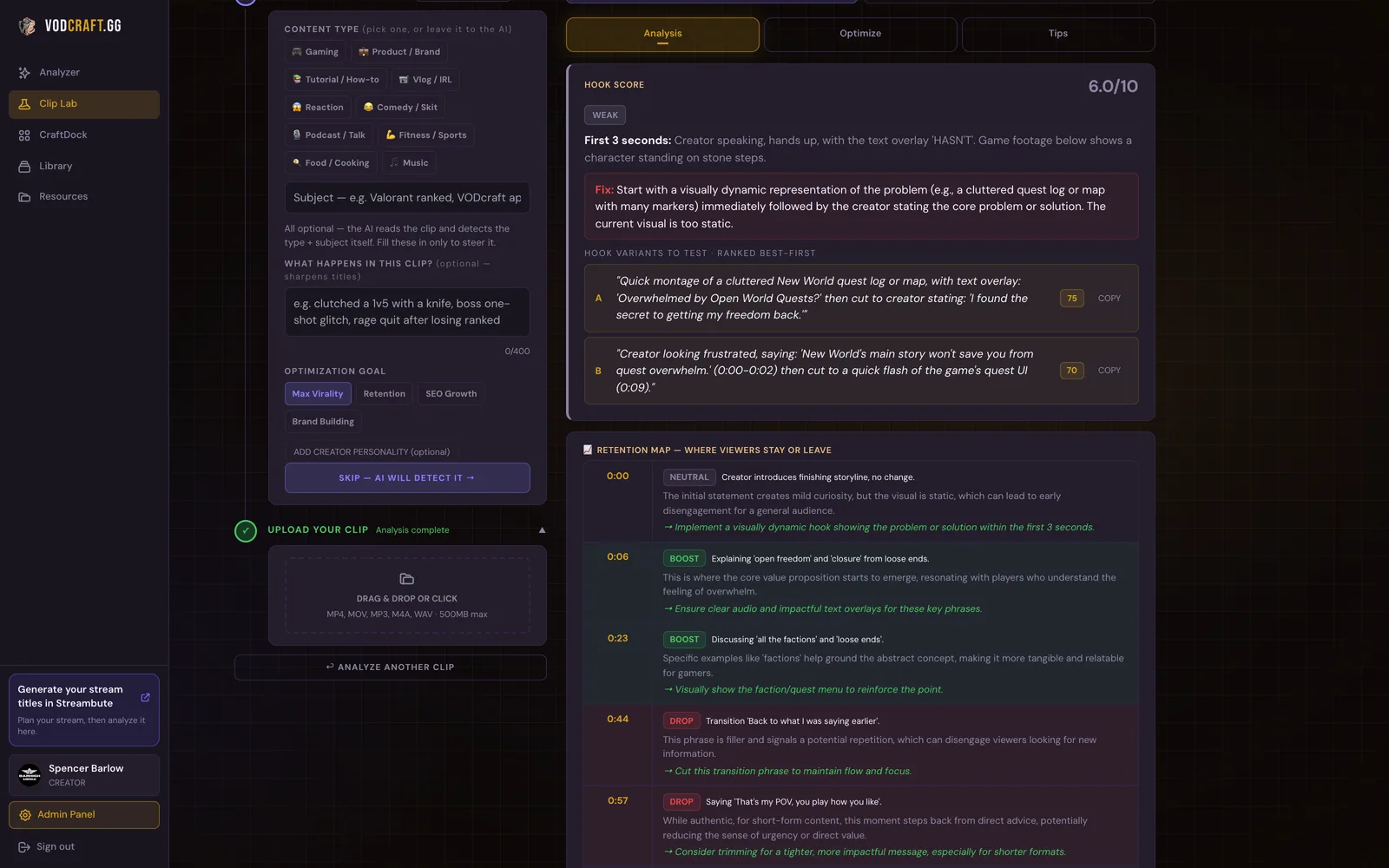
VODcraft grades the first three seconds of every clip candidate and suggests hook variants — including where the cut should actually start.
Try VODcraft free →The takeaway
Three seconds. One thumb. Two moves: open a gap or lead with the payoff.
Do this with your next clip before posting: watch only the first three seconds, muted, then stop. Ask what a stranger knows at that point. If the answer is "someone is playing a game" — recut it. Move second zero later, add one overlay line, put the face on screen. The clip you almost posted and the clip that pops are usually the same footage with a different starting frame — and once you can see hooks, you'll never write a title the same way either.
The Streamer Blueprint, 90-Day Growth Roadmap, StreamFinance tracker, Media Kit template and more. No cost.
I built VODcraft because I was spending more time scrubbing my own VODs than actually improving my streams. Everything on this blog comes from streaming, failing, and fixing it.