The clip I was sure about: a genuine 1v4 clutch, mechanically my best play of the month. I posted it everywhere. 214 views.
The clip I almost didn't post: me confidently walking off a ledge mid-sentence while explaining my "safe rotation strategy." I posted it as an afterthought. It did 40x the clutch clip.
That gap bothered me enough to figure out why — and the answer isn't luck or the algorithm hating you. Viral clips share three structural properties, and my clutch clip failed all three.
Property 1: The hook survives a cold, muted scroll
Here's the brutal context your clip lives in: a stranger, mid-scroll, sound off, zero idea who you are. You have about three seconds of their attention — and if the clip doesn't visually justify itself in that window, it's gone.
My clutch clip opened with... me looting. The clutch started at second 9. To me, second 0 was already tense — I knew what was coming. The stranger didn't. Nine seconds of a stranger looting is eight seconds more than anyone gives you.
The ledge clip opened with me mid-sentence, gesturing confidently — and anyone watching could see the ledge. The joke was armed from frame one. That's a hook: the viewer knows something is about to happen and stays to see it. The 3-second hook has its own rules — it's the highest-leverage skill in short-form.
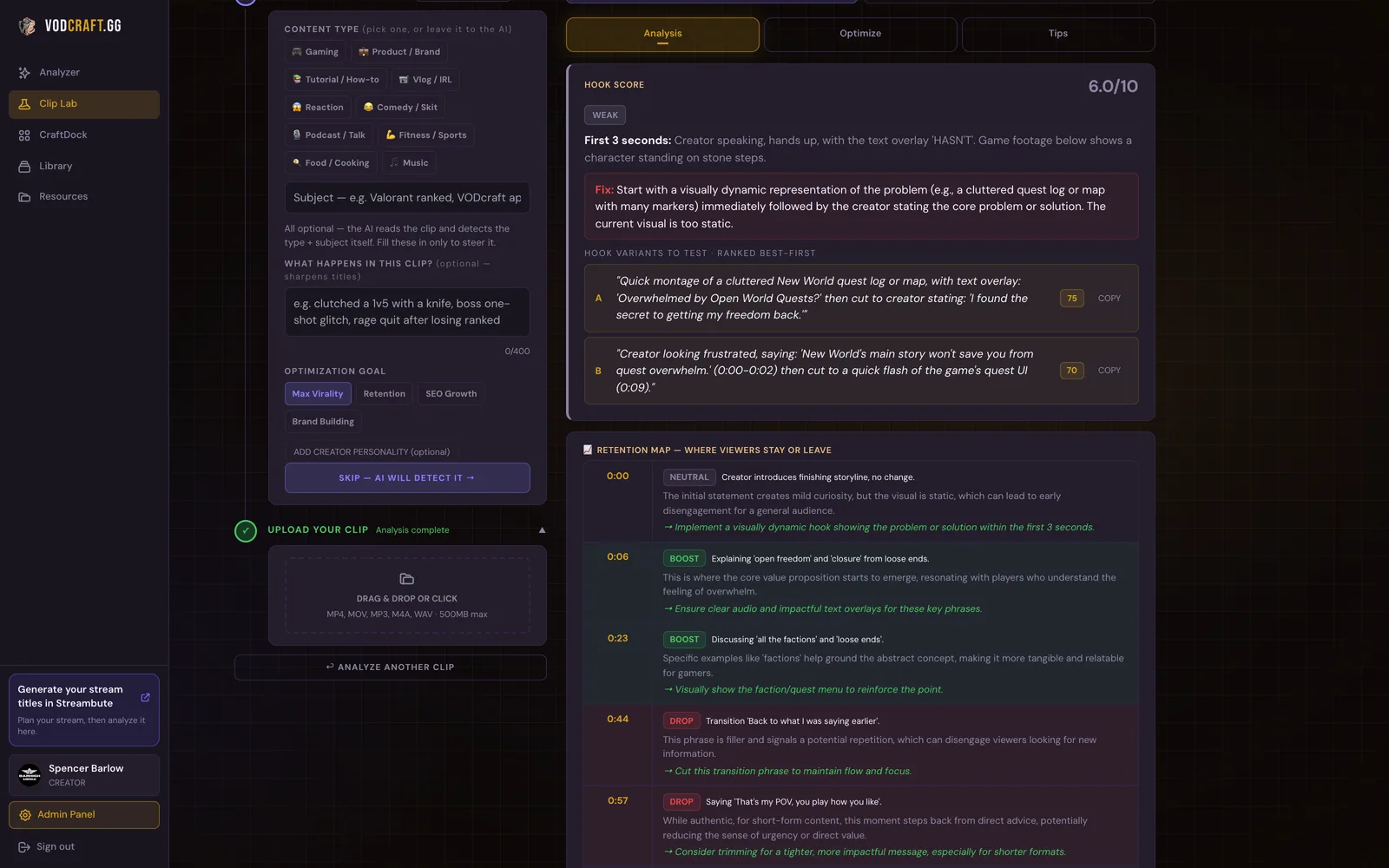
Property 2: The payoff placement matches the platform
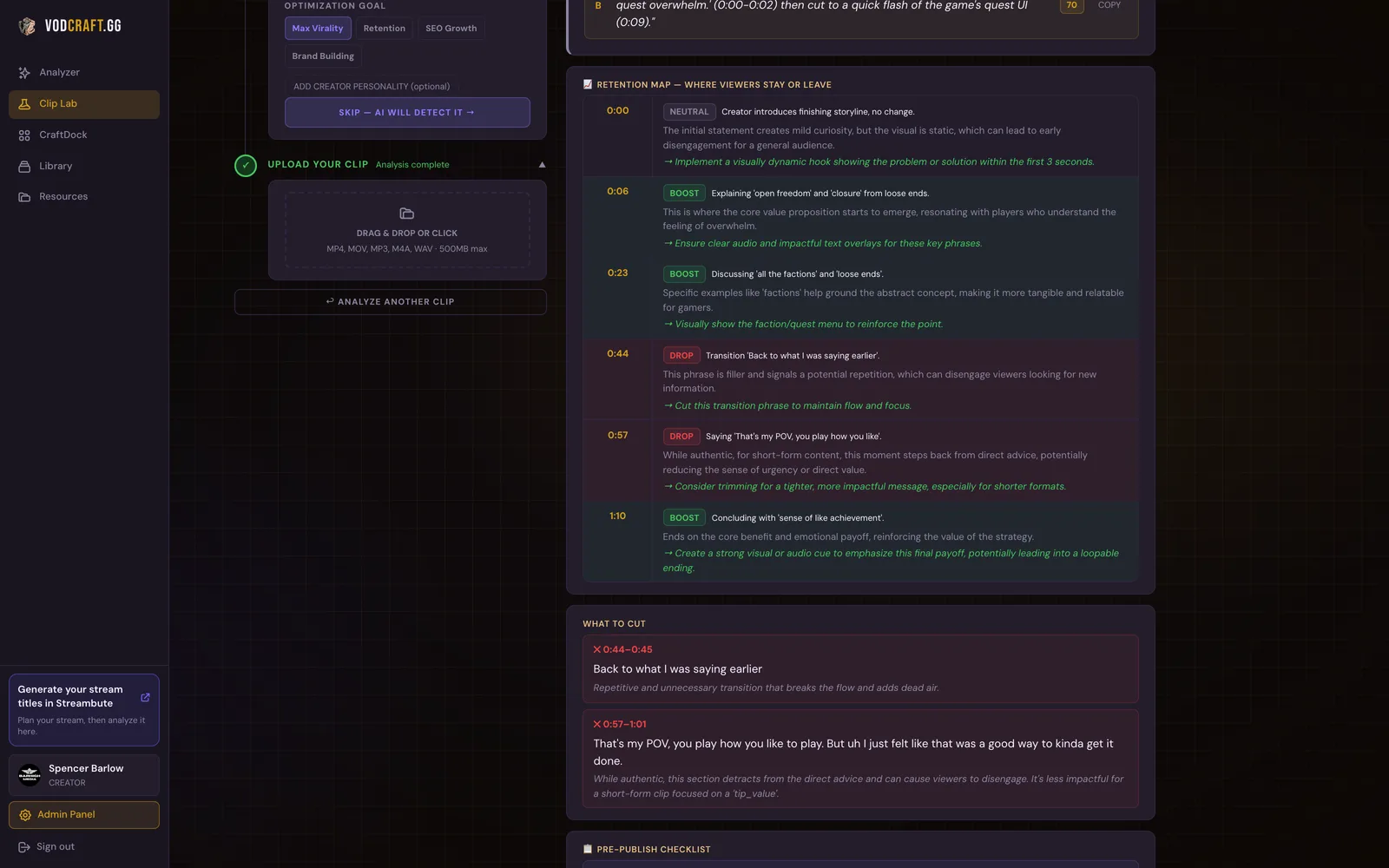
Retention isn't one number — it's a shape. Great clips hold a rising line: tension builds, payoff lands, get out. The killers are the flat stretches — every second where nothing escalates, a percentage of viewers leaves forever.
Map your clip honestly:
- 0–3s: does something visibly promise a payoff?
- Middle: does tension rise, or does it plateau? Plateau = trim it.
- Payoff: does it land at the peak of attention, or after the impatient 60% already swiped?
- After the payoff: you get 2–3 seconds of afterglow — the laugh settling, the reaction — then END. Every second past that decays your completion rate, and completion is the strongest signal you send the algorithm.
My clutch clip's real shape: 9 flat seconds → 20 rising seconds → payoff → 15 seconds of me looting the bodies. The platform read: weak completion, no distribution. Nobody sees the great middle of a clip they swiped away from at second four.
The Streamer Blueprint, 90-Day Growth Roadmap, StreamFinance tracker, Media Kit template and more. No cost.
Property 3: A stranger has a reason to share it
Views come from the algorithm; virality comes from sharing — and people share for identity, not quality. A share says something about the sharer: "this is SO us," "you have to see this," "tag someone who does this."
The ledge clip was shareable because it's universal — everyone knows someone with unearned confidence. You don't need to know me, my game, or my rank to tag your friend. The clutch clip was impressive, but impressive is only shareable to people who understand how hard it was — a tiny fraction of scrollers. Skill clips share narrow. Relatable failure shares wide.
Before posting, ask: who specifically forwards this, and to whom? If you can't picture the person, it's a good clip — not a viral one. Post it anyway, but calibrate your expectations.
The full autopsy, side by side
| | Clutch clip (214 views) | Ledge clip (40x) | |---|---|---| | First 3 seconds | Looting, silence | Confident speech + visible danger | | Shape | Flat → rise → payoff → 15s decay | Instant arm → payoff → out in 22s | | Stranger test | Needs game knowledge | Universal | | Share trigger | "Nice play I guess" | "Tag your overconfident friend" |
Nothing about this was luck. The ledge clip was structurally superior; I just couldn't see it because I was grading content by how it felt to live it, not how it reads to a stranger.
VODcraft scores every clip candidate on exactly these properties — hook strength, retention shape, who'd actually share it — before you spend time editing the wrong moment.
Try VODcraft free →The takeaway
Your best play and your best clip are usually different moments. The play is about skill; the clip is about structure — hook, shape, shareability.
Tonight's exercise: take your last posted clip and rewatch it as the stranger — muted, cold, thumb hovering. Count the seconds until something visibly promises a payoff. If it's more than three, you've found your 214-view problem — and your title was probably carrying more weight than it should.
The Streamer Blueprint, 90-Day Growth Roadmap, StreamFinance tracker, Media Kit template and more. No cost.
I built VODcraft because I was spending more time scrubbing my own VODs than actually improving my streams. Everything on this blog comes from streaming, failing, and fixing it.