I'm a Twitch Affiliate. Let's start there — this isn't a Partner writing a victory lap; it's someone in the middle of the same climb, sharing what the data and the honest Partners actually say, minus the motivational fog.
The formal Partner path: 25 hours streamed, 12 unique days, 75 average concurrent viewers over 30 days. Everyone fixates on the checklist. The checklist is a symptom. The disease is everything underneath it.
The brutal math of 75 average viewers
Average — not peak. To average 75, you need a floor of dozens of humans who show up at your start time and stay for hours, week after week. Raids and hosts spike a night; they don't move a 30-day average.
That means the question is not "how do I get more viewers?" It's: why would 75 people make watching me a habit? Habits need three things — they know when you're on, they know what they'll get, and what they get is better to them than their alternatives. Which maps to exactly three changes.
Change 1: From streaming a lot → streaming predictably
Affiliates grind hours. Partners keep appointments. It sounds cosmetic; it's structural — habit formation literally requires repetition at consistent times. Every schedule slip resets the habit-forming clock on your most loyal viewers.
The honest audit: pull your last 30 days. Same days? Same start times, within 30 minutes? If not, hours streamed is a vanity number — you're generating content, not appointments. Fewer, absolutely reliable slots beat more chaotic ones. Three sacred sessions a week is a Partner pattern; six random ones is an Affiliate pattern with extra burnout.
Change 2: From good moments → good retention
Growth at this stage isn't about more discovery — it's about leaking less. Twitch's browse page delivers strangers to everyone; Partners keep theirs.
The retention machinery is everything this blog keeps hammering: kill the dead air, state an objective every stream, run open loops, actually answer chat. None of it is glamorous. All of it compounds — because a 5% improvement in how long the average visitor stays, multiplied across every visitor for six months, IS the difference between 40 and 75 average.
The mechanism to build: review every stream. Partners either do this or have editors who do. The perform → review → adjust loop is the single most predictive habit — your analytics dashboard alone won't do it.
The Streamer Blueprint, 90-Day Growth Roadmap, StreamFinance tracker, Media Kit template and more. No cost.
Change 3: From "streams games" → is a channel
Here's the thing the checklist can't measure: at 75-average scale, you are no longer a person playing games — you're a destination with an identity. Every Partner you can think of, you can describe: the one who does X, the one whose community does Y.
If your viewers can't finish "oh, they're the one who ___," strangers definitely can't — and un-describable channels don't get recommended, don't get word-of-mouth, and don't turn drop-ins into regulars. This is the content pillars problem, and it's usually the real blocker for talented streamers stuck at the same number: they're good at streaming and bad at being a specific thing.
The uncomfortable exercise: ask five regulars to describe your channel in one sentence. If you get five different answers, identity is your bottleneck — not effort.
What DOESN'T have to change
Worth saying, because the grind mythology hurts people:
- You don't need to stream more hours. Past ~15 focused hours a week, returns collapse. Partners aren't outworking you; they're out-structuring you.
- You don't need to play what's trending. Big categories bury small streamers. A describable identity in a mid-size category beats anonymity in a huge one.
- You don't need to burn out as proof of commitment. The climb takes quarters, not weeks. Sustainable beats heroic — every time, over any timeline that matters.
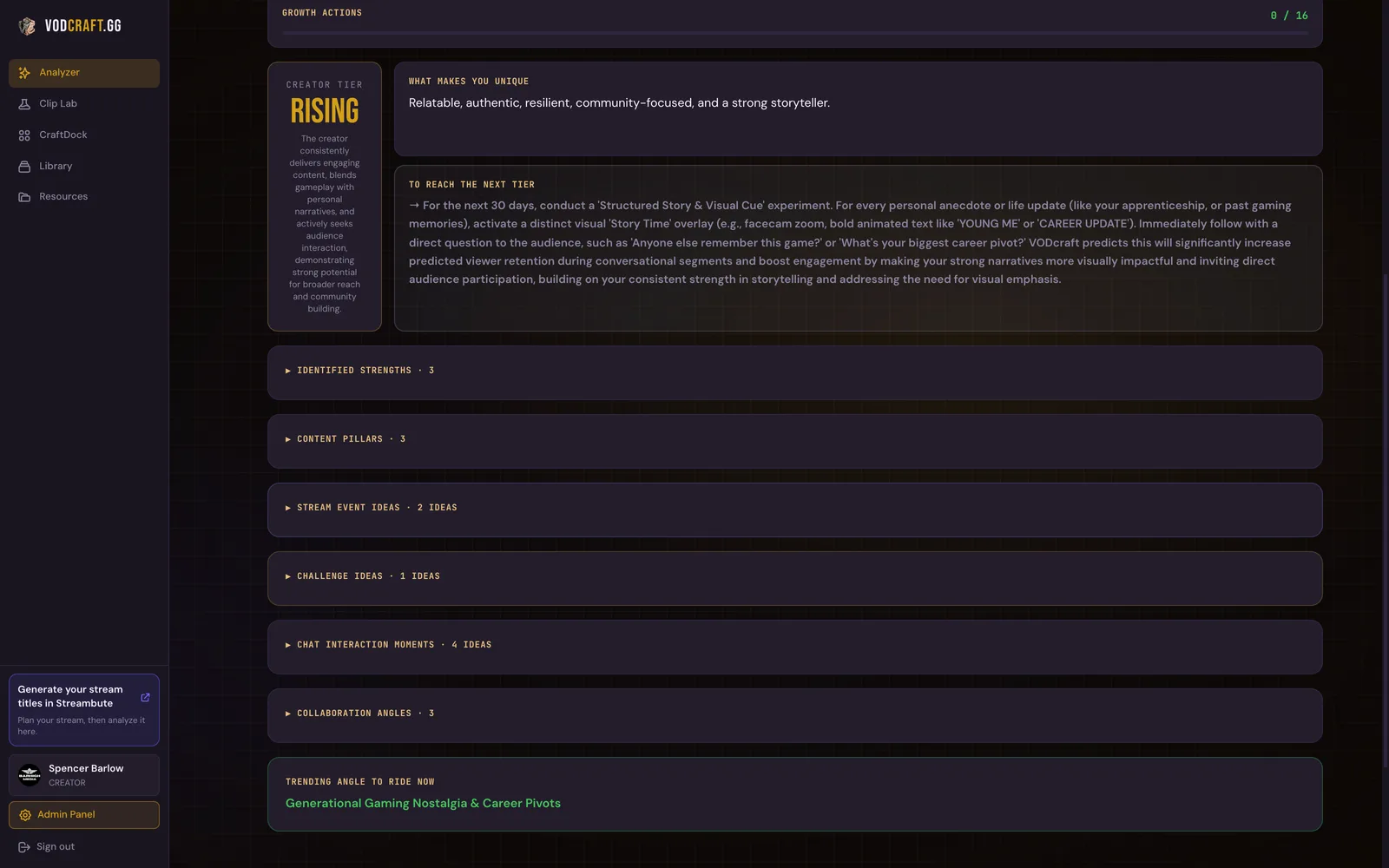
VODcraft's Growth analysis reads your actual streams and tells you which of these three changes is YOUR bottleneck — identity, retention, or structure.
Try VODcraft free →The takeaway
Partner isn't a bigger Affiliate. It's a different shape: predictable schedule, leak-proof retention, describable identity. The 75 number falls out of those three — never the other way around.
This week, grade yourself honestly, one line each: Could a viewer set a watch by me? Does my average visitor stay longer this month than last? Can my regulars describe me in one sentence — the same sentence? The "no" you just winced at is your entire roadmap for the next quarter.
The Streamer Blueprint, 90-Day Growth Roadmap, StreamFinance tracker, Media Kit template and more. No cost.
I built VODcraft because I was spending more time scrubbing my own VODs than actually improving my streams. Everything on this blog comes from streaming, failing, and fixing it.