Take an edit you admire from any big gaming YouTuber and run this experiment: watch two minutes muted, then the same two minutes with audio. Muted, it's competent footage. With sound, it has momentum — tension that builds, payoffs that hit, jokes that land harder.
Same cuts. The difference is a music strategy. And it's the least-taught skill in the entire streamer-to-YouTuber pipeline — editors learn cuts and captions, then drop one lo-fi track under forty minutes of footage and wonder why the video feels flat.
The core idea is simple: music's job is to tell the viewer what to feel before the footage proves it. That means it changes when the feeling changes — by section, not by video.
Score by section, not by video
Every gaming edit breaks into recurring section types. Each has a job, and each job has a sound:
The opening (first 30–60s). Job: momentum. The viewer just arrived and is deciding whether to stay — the audio equivalent of the 3-second hook. Mid-tempo, confident, driving — not epic (you haven't earned epic yet), not sleepy. Think "something is underway."
Exploration / downtime. Job: warmth without drag. This is where lo-fi actually belongs — light, textural, low-attention. The trap: letting it run into the next section. Downtime music under rising action kills the rise.
Combat / high stakes. Job: urgency. Percussion-forward, faster BPM, thinner melody (melody competes with your commentary — drums don't). And the oldest trick that still works every time: cut the music entirely for the two seconds before the biggest moment. Silence is the loudest sound in your toolkit; it makes the payoff detonate.
Puzzle / focus segments. Job: thought without boredom. Minimal, repetitive, almost hypnotic — arpeggios, soft synths. This section most tolerates (wants) repetition; changing tracks here feels jarring.
The fail / comedy beat. Job: timing. Either hard-stop the music on impact (the record-scratch instinct, minus the cliché scratch) or swerve into something absurdly wrong for the moment. A death scored by smooth jazz is funnier than a death scored by nothing — but only if the music reacts.
The outro. Job: landing. Resolve downward — slower, warmer, done. Ending on high-energy music makes the video feel cut off; ending on resolution makes it feel finished, and finished feelings convert to subscriptions.
The Streamer Blueprint, 90-Day Growth Roadmap, StreamFinance tracker, Media Kit template and more. No cost.
The mixing rules (where good song choices go to die)
Right tracks, wrong mix, ruined edit. The five rules:
- Voice is king: music sits at −20 to −15dB under commentary. If a viewer ever rewinds to hear what you said, the music was too loud. When in doubt, lower it.
- Duck, don't fight. Sidechain/duck the music a few dB whenever you speak (every NLE does this; even manual keyframes work). The pros' edits breathe around the voice — that's the move.
- Cut on musical phrases. Track changes land on the music's own boundaries (bars, drops), roughly synced to your scene cuts. Mid-phrase swaps feel like a radio scanning stations.
- Match energy to footage, not to taste. You love that track; it's still wrong under a puzzle segment. The section's job picks the music — your taste picks between qualifying tracks.
- Copyright is a strategy decision, not an afterthought. Epidemic/Artlist subscriptions, YouTube's free audio library, or NCS-style channels — decide once, build a per-section playlist folder from safe sources, and never re-litigate it per video. One strike teaches this lesson at maximum price.
The 80/20 version
No time for any of this nuance? The minimum viable music strategy: three playlists — one "moving" (exploration/openers), one "urgent" (fights/stakes), one "warm" (comedy/outro). Swap between them at section changes, duck under voice, silence before big moments. That alone puts you ahead of 90% of stream edits — and pairs with cutting the dead air to transform how your videos feel.
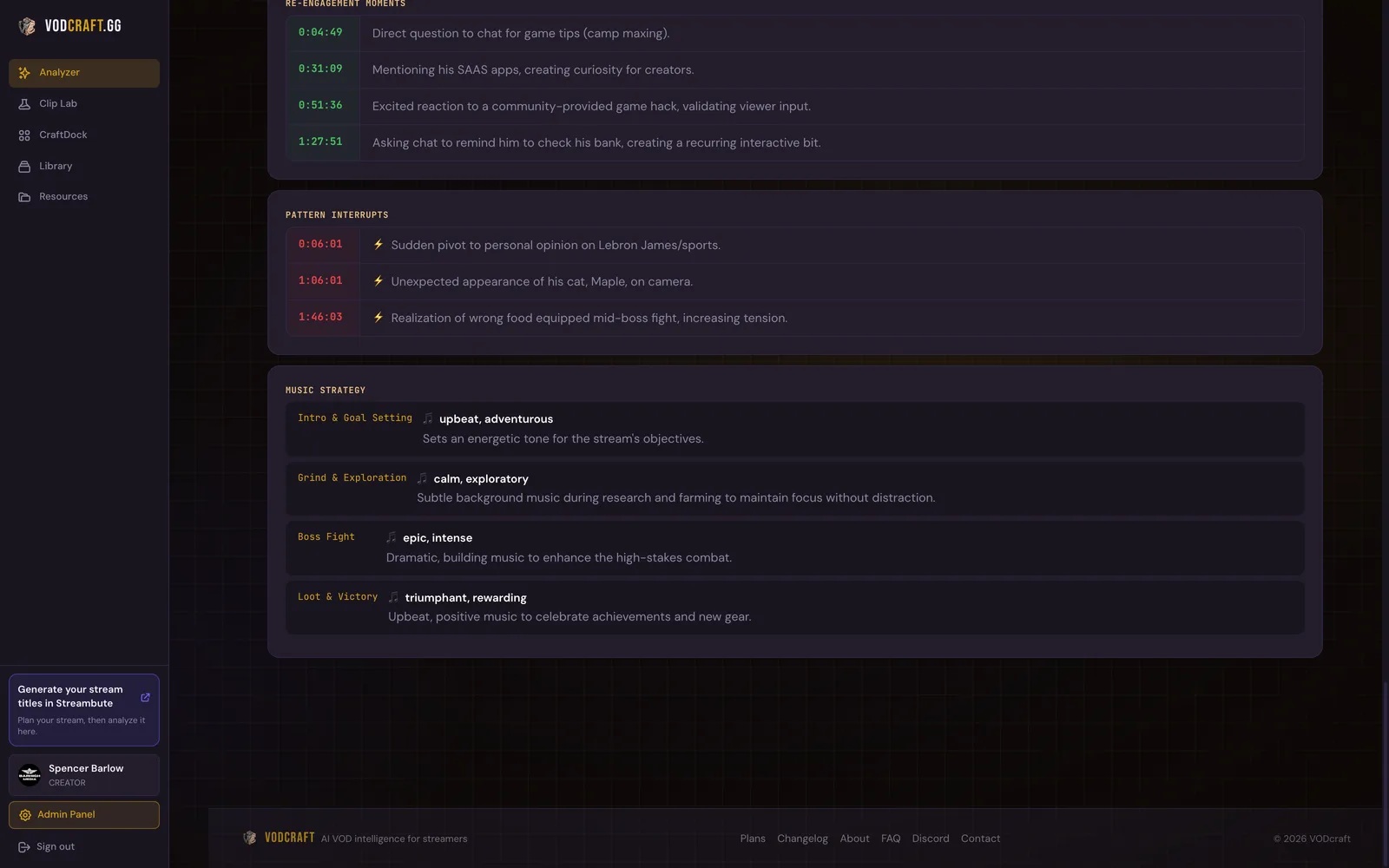
VODcraft maps your stream's sections and suggests a music mood for each — the strategy layer, generated from the VOD's actual structure.
Try VODcraft free →The takeaway
Music isn't decoration on top of the edit — it's the emotional script running under it. Section by section: momentum, warmth, urgency, thought, timing, landing.
Next edit, do exactly one thing differently: find your biggest moment and cut the music for the two seconds before it. Feel what that does. That's the door into the whole craft — and once you hear it, you can't unhear every flat edit on your feed, including your old ones. That discomfort is the skill installing. The full framework for structuring the edit itself lives in story arcs — music is what makes those arcs audible.
The Streamer Blueprint, 90-Day Growth Roadmap, StreamFinance tracker, Media Kit template and more. No cost.
I built VODcraft because I was spending more time scrubbing my own VODs than actually improving my streams. Everything on this blog comes from streaming, failing, and fixing it.