The reason most stream-to-YouTube edits fail isn't editing skill. It's that streamers treat the edit as a highlights reel — best moments, back to back, music on top. And highlights reels are weirdly unwatchable: fifteen peaks in a row with no valleys is just noise. Nothing means anything because nothing was at stake.
Here's the reframe that fixes it: your stream already contains a story. An objective was declared. Obstacles appeared. There was a low point where it looked lost, and a resolution where it wasn't (or gloriously was). You performed a three-act structure live without thinking about it — because struggle toward a goal is narrative, automatically.
The edit isn't creation. It's excavation.
Finding the arc in your VOD
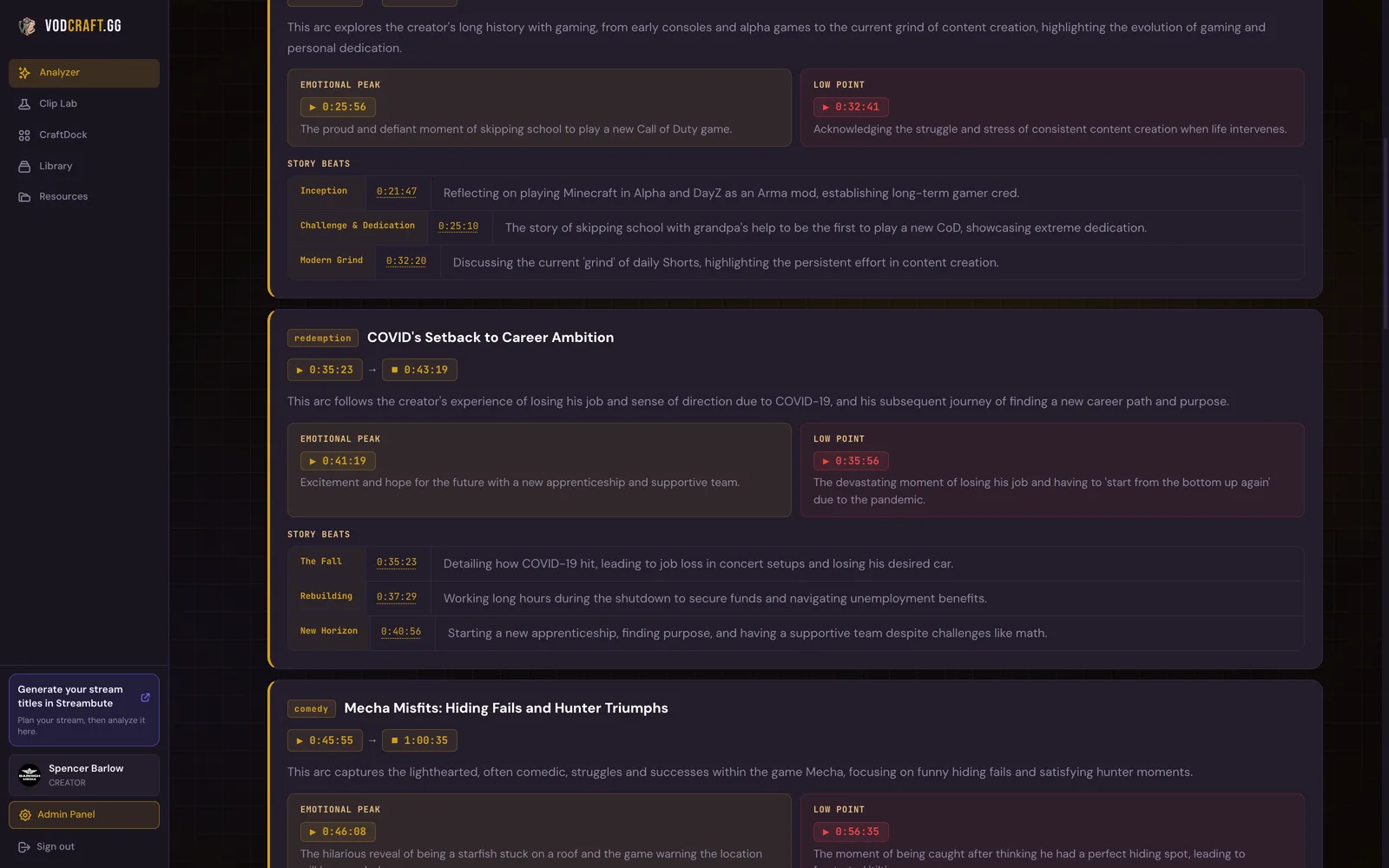
Rewatch (or skim at 2x) with a narrative lens instead of a highlights lens. You're mapping five beats:
- The objective — the moment you declared what tonight was about. "We're hitting Diamond." "This boss dies today." This is your video's opening, almost regardless of when it happened.
- Rising obstacles — the attempts that escalated. Not all of them: the ones where something changed — a new strategy, a closer call, rising tilt.
- The low point — the moment it genuinely looked lost. The deaths piling up, the "maybe we just can't do this," the almost-quitting. This is the beat every highlights reel deletes, and it's the most important one in the video. No valley, no peak.
- The turn — where something shifted: the adjustment, the "wait... wait, this might work."
- The payoff — the win (or the catastrophic, hilarious loss — failure arcs work too, they just resolve in comedy instead of triumph).
Map those five timestamps and your edit has a spine. Everything in the VOD either serves one of those beats or gets cut.
Building the edit from the spine
Open on the objective, fast. Within the first 30 seconds, the viewer knows what's at stake tonight. If you declared it messily live, cold-open on the payoff's first two seconds, then cut to the objective — same trick as clip hooks, stretched to long form.
Escalate the middle — don't complete it. Six failed attempts don't need six appearances. Keep attempt one (establishes difficulty), the closest heartbreaker (raises stakes), and the disaster (comedy or despair, per your arc). Montage the rest in fifteen seconds. Escalation is a feeling, not a documentary.
Protect the low point. Let it breathe — the quiet frustration, the deep sigh, the real doubt. Instinct says cut it ("boring, sad"). Instinct is wrong: this is where the viewer starts caring whether you make it. Every underdog story ever made knows this beat is the engine.
Land the payoff with everything. Full reaction, chat exploding, don't trim the scream. And cut the music the two seconds before — the silence-then-eruption combo is the entire reason people make it to the end of a video.
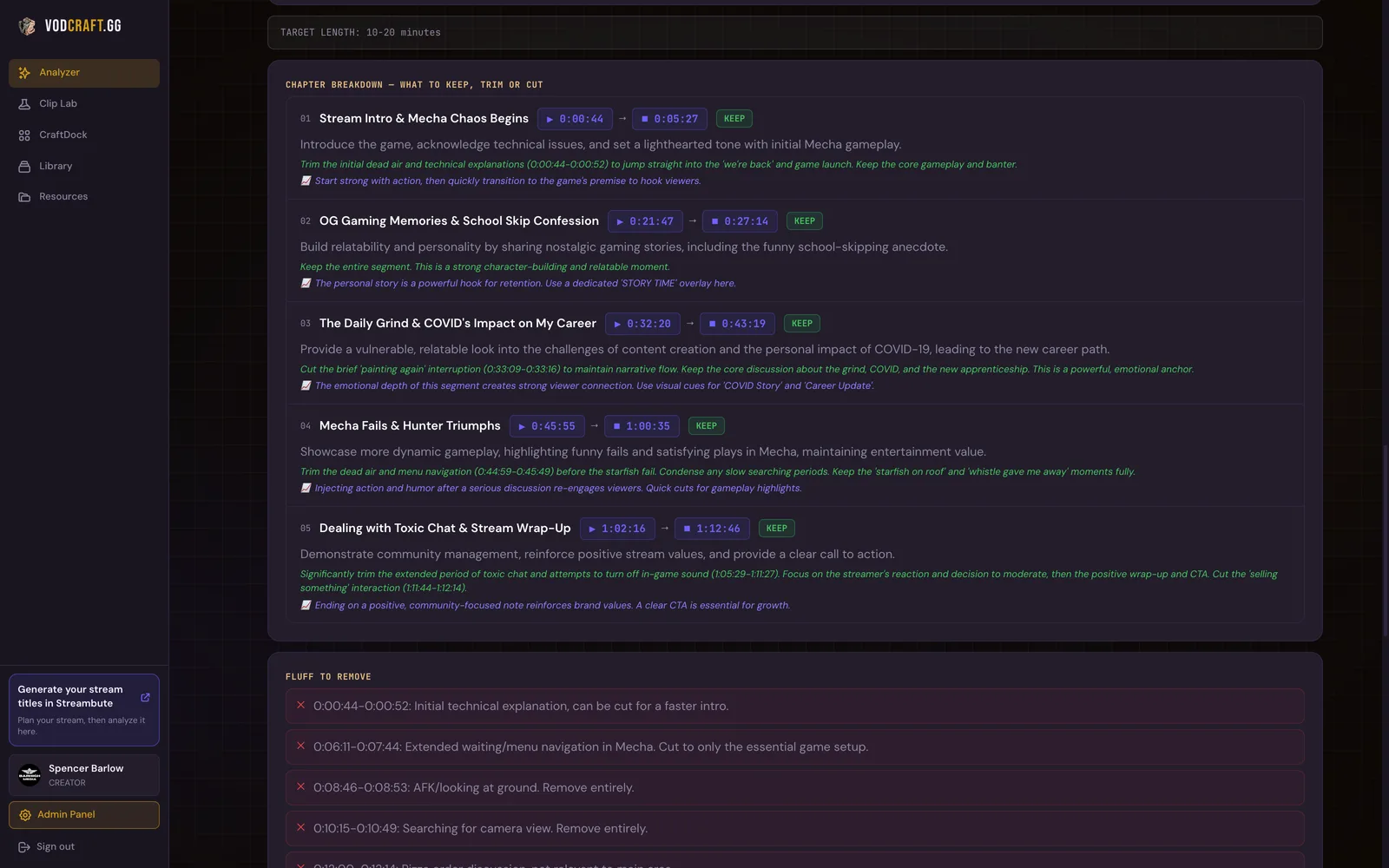
Resolve, then stop. Thirty seconds of afterglow — the "I can't believe that worked," the thanks, the tease for next time. Then end. Don't let a finished story keep talking.
The Streamer Blueprint, 90-Day Growth Roadmap, StreamFinance tracker, Media Kit template and more. No cost.
What if the stream didn't have an arc?
Sometimes you skim the VOD and there's... no story. No objective, flat energy, four pleasant aimless hours. Two honest responses:
- Mine it for clips instead — arcless streams still contain moments, and the clip pipeline doesn't need a narrative.
- Fix it upstream. A stream with no arc is a stream with no declared objective — the same root cause behind flat retention. The fix isn't better editing; it's opening Thursday's stream with a goal. Streams with stakes produce edits with stories, automatically. This is the secret nobody says: becoming a better streamer and generating better edit material are the same activity.
VODcraft maps the narrative arc of every stream automatically — objective, low point, emotional peak, chapter-by-chapter keep/trim/cut. The excavation, done.
Try VODcraft free →The takeaway
Stop asking "what were my best moments?" and start asking "what was the story of that stream?" Objective, obstacles, low point, turn, payoff — five timestamps, and the edit builds itself around them.
This week: take your last decent VOD and just find the five beats. Write five timestamps, nothing more. Whether or not you ever cut the video, you'll never watch your own streams the same way again — and your next stream will quietly start shaping itself into a story while you play. That's the loop closing.
The Streamer Blueprint, 90-Day Growth Roadmap, StreamFinance tracker, Media Kit template and more. No cost.
I built VODcraft because I was spending more time scrubbing my own VODs than actually improving my streams. Everything on this blog comes from streaming, failing, and fixing it.